How do we best make sense of the new dietary guidelines? Part 1

Updated: Jan 27

The newest version of the Dietary Guidelines for Americans, the 10th edition, for 2025-2030, was released in January 2026. Although other editions have generated some controversy, this edition has created more than any previous version.
As a nutrition communicator, I am responsible for communicating nutrition science and dietary guidelines to the public and to fellow professionals. With the controversy surrounding the recent edition, how do we best make sense of the new guidelines and communicate with the intent to bring clarity to the confusion?
When I taught at Purdue, one of the courses I taught was Diet Selection and Planning. The Dietary Guidelines were a key topic covered each semester. As I reflect on the newest version, I keep asking myself, how would I teach this to future nutrition professionals? In this series, I will share my answer.
In this week’s blog, we will look at the history of the guidelines and why and how they are developed.
What is the history of the Dietary Guidelines for Americans?
The history of the official “Dietary Guidelines for Americans” parallels my career in nutrition and dietetics. The first edition was released in 1980, while I was in grad school. Every five years since, the updated scientific report and corresponding guidelines impacted my work in significant ways. To fully understand the guidelines, understanding their history and purpose is essential. Here’s what I taught my students…
Dietary Guidance pre-1980:
The “Dietary Guidelines for Americans” were preceded by dietary guidance from the government dating back as far as 1894, when W.O. Atwater published the original food composition tables and dietary standards. In 1902, he published dietary guidance in the Farmers’ Bulletin. See the first image above.
Historically, the United States Department of Agriculture has been the primary agency for formulating and disseminating dietary guidance. In 1916, USDA published “Food for Young Children” with 5 food groups: milk and meat, cereals, vegetables and fruit, fats and fatty foods, sugars and sugary foods, which in 1917 came out as a buying guide for the general public. In these early versions of dietary guidance, the emphasis was on adequacy of diet, encouraging Americans to get enough of a variety of foods.
During the Depression, in the 1930’s, the emphasis was on purchasing wholesome food that was affordable. In 1933, the USDA published buying guides using 12 food groups in food plans at 4 cost levels.
In 1941, the 1st edition of the RDAs was released by the Food and Nutrition Board of the National Academies of Science. During the War years in the 1940’s, the guidance was promoted as a “foundation” diet. In other words, the suggested number of servings was intended to be the minimum amount needed for good health.
In 1943, USDA published the Basic 7 Food Guide: Milk; Meat; Breads and Cereals; Leafy greens and yellow vegetables; Potatoes and other vegetables and fruits, Citrus, tomatoes and salad greens; Butter or margarine. Which was renamed in 1946 the “National Food Guide.” The 1943 guide states, “In addition to the Basic 7… eat any other foods you want!” Excess intake was not a concern.
1956 was the year USDA came out with the “Basic 4 Food Groups” – milk, meat, fruit and vegetables, breads and cereals. The “Basic 4” remained a component of dietary guidance until 1992.
In 1977, the “Dietary Goals for the United States” were published in response to the Senate Select Committee Report (AKA the McGovern Report), which described a growing body of evidence that dietary excesses of fat, saturated fat, cholesterol, and sodium were related to chronic disease. See the quote at the end of the blog from this report.
This was the beginning of a change in dietary advice from assuring an adequate diet to avoiding overconsumption of certain components in food. See the list of goals here: https://www.sciencedirect.com/science/article/abs/pii/S0022318277800678
In 1978, the USDA and HHS (formerly called the Department of Health, Education, and Welfare) established a Joint Coordinating Committee. This committee appointed a task force of scientists within the two Departments to develop dietary guidance statements for the public based on the current scientific evidence regarding the relationship of diet to health and disease. This led to the first edition of the Dietary Guidelines for Americans.
Dietary Guidance post-1980:
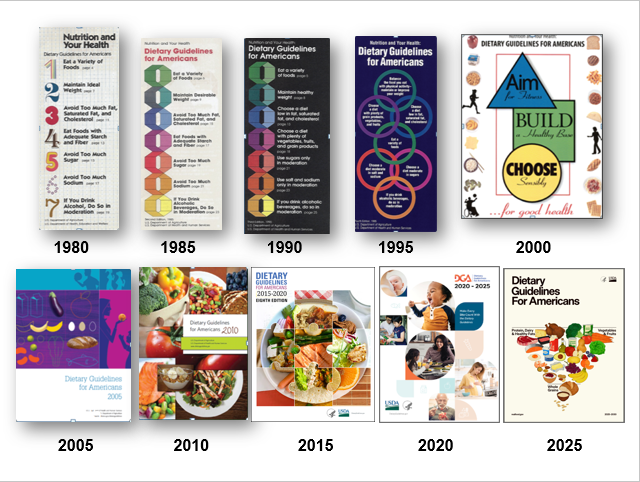
The US Dept of Agriculture and the US Dept of Health and Human Services have been tasked with providing dietary guidance to American consumers since the first edition of the Dietary Guidelines for Americans was released in February 1980.
In 1983, the Joint Nutrition Monitoring Evaluation Committee (JNMEC) was established. It is a federal advisory committee jointly sponsored by USDA and HHS. The committee was formed to report on the nutritional status of the U.S. population based on data collected by the National Nutrition Monitoring System.
The National Nutrition Monitoring and Related Research Act of 1990 (P.L. 101-445), mandates HHS and USDA jointly publish the Dietary Guidelines for Americans at least every 5 years. HHS and USDA alternate providing administrative leadership for developing each edition of the DGAs.
Since 1992, in addition to the guidelines, a food guidance icon has been used to help consumers remember and implement the guidelines. The first icon used was the Food Guide Pyramid. The shape of the pyramid depicted the relative amounts of each food group included in a healthy diet. This icon evolved into MyPyramid in 2005, with an emphasis on individualizing your choices and adding physical activity.
In 2011, the pyramid was replaced by MyPlate. The goal of this icon was to help consumers create a balanced intake at each meal. The MyPlate website has not been removed, but its future appears in question.
The 10th edition of the guidelines reintroduced the pyramid as an inverted pyramid – similar to the one for journalists - which emphasizes the content at the top, promoting protein sources such as red meat and full-fat dairy, along with healthy fats and fruits and vegetables. Grains, which formed the base of the original pyramid, are minimized, with only whole grains included. This icon is certainly part of what makes the newest guidelines controversial. More on that later in the series. First…
What is the purpose of the Dietary Guidelines for Americans?
In addition to understanding the DGAs through the lens of history, we need to know why and how they are developed. Let’s begin with why.
The Dietary Guidelines are designed for healthy Americans as well as those at increased risk of chronic disease, to promote health and prevent disease. They are not meant to be used as dietary treatment for disease. Before 2020, they were for Americans ages 2 and older. The 2020-2025 Dietary Guidelines added specific guidance for birth to age 2.
The Dietary Guidelines are to be based on the most current and highest quality scientific evidence available.
The DGAs form the foundational policy for all Federal food and nutrition programs, such as SNAP, WIC, and School Lunch. Federal agencies are responsible for implementing the dietary guidelines.
The target audience for the policy document that accompanies the guidelines is policymakers, nutrition educators, and health professionals.
How are the Dietary Guidelines for Americans developed?
Now that we know their purpose, let’s explore how they are developed during each five-year cycle. The DGAs are developed and implemented in four phases:
Phase 1: The Dietary Guidelines Advisory Committee is chartered.
Three years before the next DGAs are released, HHS and USDA solicit nominations for the DGAC. The committee is comprised of non-federal experts and special government employees who serve voluntarily. The nominees selected to serve are appointed by the HHS and USDA Secretaries.
The DGAC is governed by the Federal Advisory Committee Act, which emphasizes open involvement with public input. The DGAC has a 2-year “Charter” to complete an independent review of science and provide advice and recommendations to the federal government. They do not draft or implement policy.
I was fortunate that, since 2005, the Dietary Guidelines Advisory Committee has had multiple expert members from Purdue. While I was teaching, I was able to have a guest speaker who could speak from first person experience about the process of developing the guidelines. This front-row seat has given me an appreciation for the validity of the guidelines.
Phase 2: DGAC holds Public Committee Meetings, Reviews the Science, and Writes the Advisory Report.
Once the DGAC is appointed, agency work groups identify topic areas and research questions to examine the current scientific evidence, and a request for public comments is initiated.
Subcommittees of the DGAC are formed to review the scientific literature and conduct systematic reviews in preparation for writing the advisory report.
Public meetings are held every 2 to 3 months.
The advisory report is submitted to the Secretaries of HHS and USDA approximately one year before the release of the dietary guidelines. The report is posted online and available for public and federal agency comment to HHS and USDA. See below for a link to the original 2025 DGAC report, which was submitted in December 2024.
Phase 3: HHS and USDA Develop Policy Document, DGAs released.
HHS and USDA consider the Advisory Report, public comments, and agency comments.
The departments prepare the Dietary Guidelines for Americans policy document.
HHS and USDA jointly publish and release the next edition of the Dietary Guidelines for Americans.
Phase 4: Dietary Guidelines are Implemented through Federal Programs.
The DGAs serve as the foundation for federal nutrition policy and programs. They are applied in food service, agriculture, health, and education. The food industry responds to changes in demand for foods to meet the DGAs.
For more background information about the Dietary Guidelines for Americans:
In next week’s post, we will explore these questions…
What happened to the 2025-2030 dietary guidelines?
Why was the original advisory report replaced?
“The purpose of this report is to point out that the eating patterns of this century represent as critical a public health concern as any now before us. We must acknowledge and recognize that the public is confused about what to eat to maximize health. If we as a Government want to reduce health costs and maximize the quality of life for all Americans, we have an obligation to provide practical guides to the individual consumer as well as set national dietary goals for the country as a whole. Such an effort is long overdue. Hopefully, this study will be a first major step in that direction.”
~ George McGovern, Chairman, Senate Select Committee, 1977
If you liked this content, please share it.


Comments