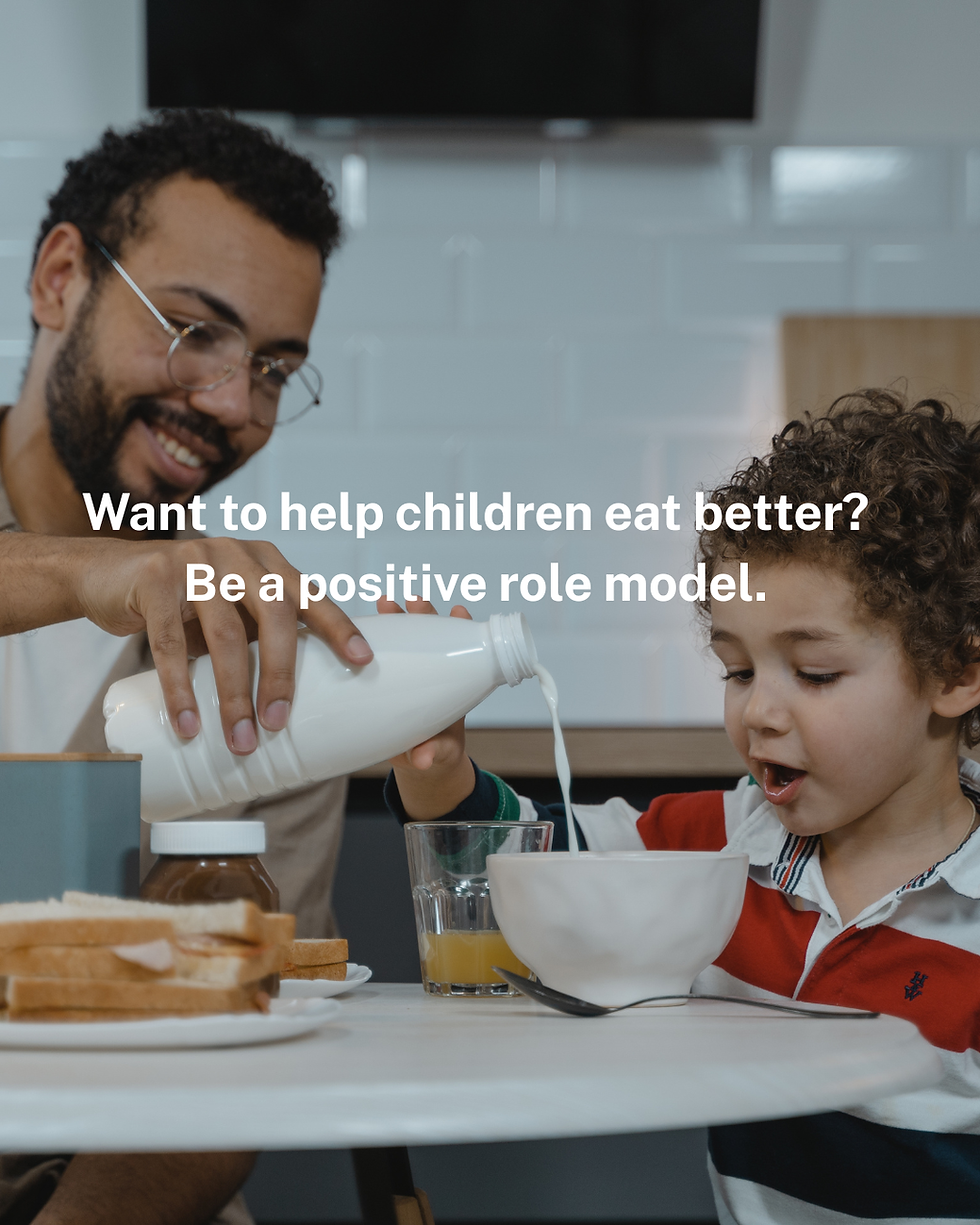
Want to help children eat better? Be a positive role model.

In my career as a Registered Dietitian Nutritionist, I’ve had the privilege of helping parents and other caregivers learn how to feed the young children in their care.
In this blog series, I will share the key principles from materials I created with a Team Nutrition grant that was titled RECIPE for Growing Healthy Children.
In this post, we will cover R, which stands for role model what we want children to be, say, and do.
Why is it important to be a positive role model?
It is important to be a positive role model because children imitate the important adults in their lives. In fact, we all imitate others that we respect and admire. And we imitate what they do more than what they say.
To make this point in workshops, I opened with a game. I would say, “We’re going to play a little game. I’ll tell you the name of the game after we play it. Follow my instructions very carefully.”
Say: “Point your index finger up to the ceiling and then touch your opposite elbow.”
Do: Touch your opposite shoulder instead of your elbow.
Say: “Hold it there and look around.”
“This game is called ‘Monkey See, Monkey Do.’ Some of you did what I said, but many of you did what you saw me do. Have you noticed that children imitate the important adults in their lives? What are some things we do as adults that contradict things we tell children? Let’s see if we can think of three good examples…”
What comes to your mind?
This discussion was followed by showing a video clip called “Copy Cat.”
How can we best help children eat better?
Here is a “quiz” I used to find out what parents and caregivers thought was the best approach to teaching healthy eating behaviors to young children.
I asked them to pick which one of the following would have the greatest impact:
Teaching via rewards and punishments: “You’ll get a sticker (or dessert…) if you eat your veggies.”
Teaching by explaining: “Eat your vegetables to get lots of vitamins.”
Teaching via structured experiences: Making stir-fry veggies together.
Teaching by example: Enjoy eating vegetables in front of the child.
The topic of this blog post is the clue to which is the best answer: Number 4.
Research in education and child development shows that teaching by example can have the greatest positive impact. When it comes to teaching healthy eating behaviors, that means enjoying eating YOUR vegetables in front of the child.
How can we be a positive role model?
To be a positive role model for eating behaviors requires that adults experience food and eating alongside the children in their care – shopping for it together, preparing food together, eating together, all in a safe and supportive manner with neutral talk about food and no body or food shame allowed.
This part of my workshops ended with participants doing a group activity. Each group was given a large piece of paper with an outline of a young child in the middle of the page. They were asked to brainstorm words and phrases that describe the “healthy” people we want the children in our lives to become and to write these inside the outline of the child.
This was followed by a discussion of how we can help children attain that ideal by brainstorming ways to role-model what we’ve just described. These ideas were written outside the child's outline. Each participant then chose and shared one or more ways they wanted to more consistently model positive attitudes about food and eating.
“Children are like wet cement. Whatever falls on them makes an impression.”
~ Haim Ginott
If you liked this content, please share it.


Comments